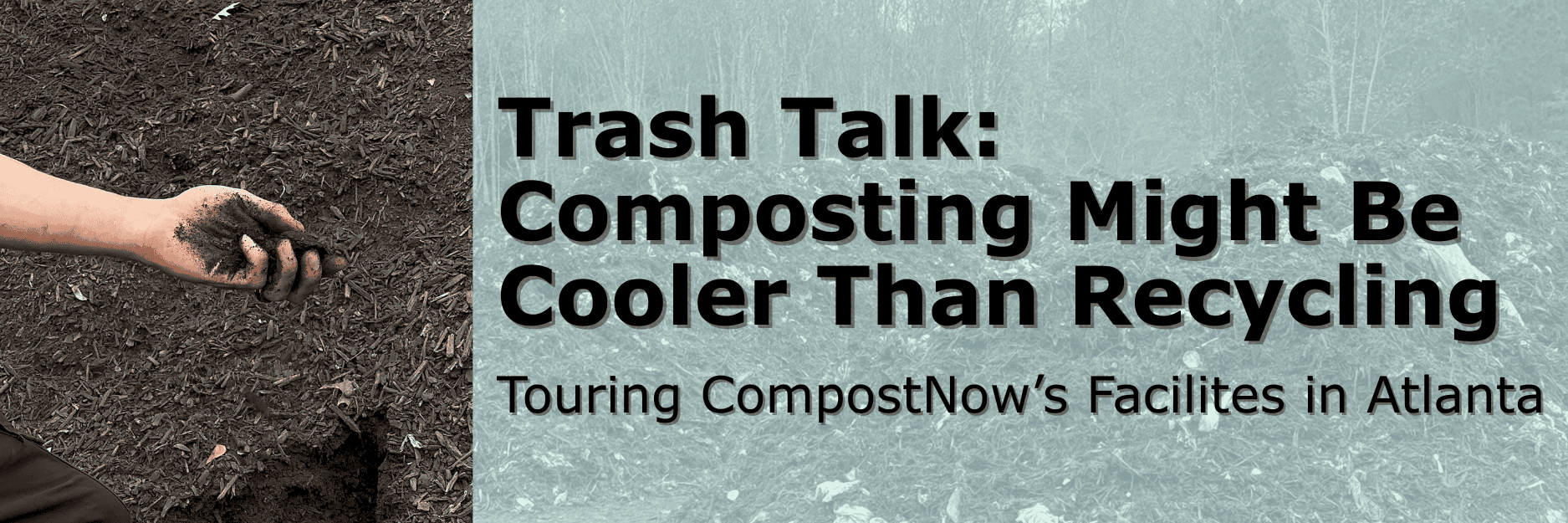


Trash Talk: Composting Might Be Cooler Than Recycling
As we gear up for our BuckheadCOMPOSTS initiative and EPA-backed compost competition next year, I’ve been on a little composting journey of my own. And I’ll admit… I went into it expecting something buggy, smelly, and maybe even a little gross.
But what I found was surprisingly clean, surprisingly simple, and honestly—surprisingly hopeful.
I’m starting to think that composting might be one of the most effective “on-ramps” into sustainability. It’s a system that feels collaborative, real, and functional. Unlike recycling—where skepticism is understandable and questions like “Does this actually get recycled?” come up often—the composting process is more transparent. If it grows, it goes. And if it goes…it turns into soil.
Let me take you on the compost tour I recently went on.
Step 1: Composting at Home (It’s Easier Than You Think)
My first stop was an apartment—our very own Charles, Livable Buckhead’s marketing & business development manager, has been using CompostNow for years. His set-up includes a cute little countertop bin (with a carbon-filter to block odors). When it fills up, he walks it down to a dedicated bin in the parking garage, just like one does with recycling.
That bin? It’s clean. Doesn’t smell. Has a child-lock lid to keep out critters with tiny paws. That was my first surprise.
CompostNow keeps the rules of sorting your scraps simple, they say: “If it grows, it goes.”
Meaning all food scraps—banana peels, eggshells, bones, veggie stems—go in the same place. No wondering. No complicated sorting. We know that organic matter can be broken down and turned into soil. And there’s something satisfying about that certainty.
Step 2: The Sorting Facility – East Point, Atlanta
Next stop: CompostNow’s facility in East Point, where scraps from apartments, restaurants, and single-family homes all come together.
Here’s what happens:
- Everything gets checked for contamination (the most common offenders are small sauce containers, dog waste bags, and non-compostable plastics).
- Bins are emptied into a big truck.
- Bins are cleaned—so residents get a fresh one each week, keeping pests and smells away.
What struck me was how straightforward this process is. Compared to a recycling facility (MRF), this system is refreshingly simple. Fewer machines. Fewer people sorting through garbage. Fewer downstream partners—and the vast majority of what’s in those bins actually makes it to the next stage. (Unlike recycling, where Atlanta has a 25% contamination rate.)
Step 3: The Compost Magic – Southern Soil Works in Grantsville, GA
And now…the place where banana peels go to be reborn.
CompostNow’s composting site (Southern Soil Works) is out in Grantsville, next to a landfill—but what’s happening there is the polar opposite of trash. They’re turning over 6,000 tons of food scraps into compost every year—with plans to scale to 50,000 tons.
This part of the process honestly surprised our whole group. No rotting smell. No rodents. No clouds of flies. Not even worms!
Instead of huge sorting machines like MRFs use (lasers, blowers, magnets—you name it), the composting process is pretty simple. CompostNow uses an aerobic windrow system:
- Greens (food scraps) are mixed with browns (wood waste).
- They’re piled into long rows—called windrows.
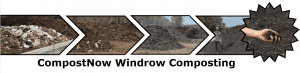
- As the organic matter starts breaking down, the temperature inside reaches up to 140°F. That heat is too intense for worms—so microbes take over. They break everything down quickly and safely. In just two weeks, you can barely tell what used to be a banana peel or chicken bone.
- The piles get “turned” often to introduce oxygen and prevent overheating (compost CAN catch fire!).
- After about two months, what used to be food is now dark, nutrient-rich compost that will go on to nourish farms and gardens.
It will cure for a few more months—but it’s pretty incredible. For decades we’ve buried all this material in landfills where it can’t break down properly—creating methane and missing the chance to put nutrients back into our soil. Meanwhile, we built whole industries to make artificial fertilizer. We had the nutrients all along.
So… What If We Just… Slowed Down?
If we as consumers took 0.5 seconds to separate food scraps…
If cities built systems to handle it…
If we truly committed to keeping nutrients in the ecosystem…
We’d cut carbon emissions.
We’d support local agriculture.
And we’d start to see environmental progress that is actually tangible.
Composting is nature’s oldest and most efficient recycling system. Maybe we should have fully embraced it from the start—before trying to tackle the much harder version of recycling man-made crazy plastics.
BuckheadCOMPOSTS
Next year, we’ll be launching BuckheadCOMPOSTS to help bring composting to more apartments and homes. We’ll collect data, host a friendly competition, build economies of scale—and show exactly where our food scraps can go when we give them a better path.
Maybe composting won’t just reduce waste.
Maybe it will restore a little faith that collective action can work.
Here’s to turning food scraps into soil—and turning skepticism into hope.
Let’s show how Buckhead recycles. 🌱