


PATH400 Community Planters Upgraded with Innovative 3D-Printed Frames
Livable Buckhead, QUIKRETE, Belter Tech, COBOD, and University of Miami partnership enhances community green space
ATLANTA – April 29, 2026— When the planters along PATH400 needed replacing, Livable Buckhead didn’t reach for lumber. Instead, a partnership with QUIKRETE, Belter Tech, COBOD and University of Miami students produced something more innovative — concrete raised beds 3D-printed using 70 percent less material than traditional methods and built to last for decades. The planter frames are shaped to spell out P-A-T-H-4-0-0 and were filled with plants by volunteers during Earth Week on Friday, April 24.
The updated planters kick off a new chapter for a garden that has been a fixture of PATH400 since 2017. For the past nine years, residents of the nearby Marian Road high-rise have maintained the raised beds, cultivating vegetables and flowers that add color to the trail and provide them with a meaningful connection to their outdoor community. The seniors will continue to maintain the upgraded planter beds.
“PATH400 has always been about bringing people together, and these new planters are a perfect reflection of that spirit,” said Denise Starling, executive director of Livable Buckhead. “We are proud to see innovation and community stewardship come together in such a visible way.”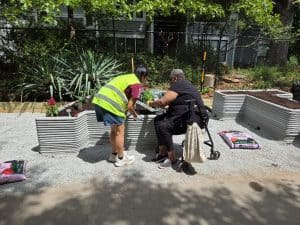
The PATH400 planter installation showcases what’s possible when emerging construction technology meets smart material coordination. Originally scoped for approximately 20 cubic yards of concrete using traditional cast-in-place methods, the project team transitioned to 3D printing approach that reduced total concrete usage to approximately six cubic yards. The shift also eliminated the need for traditional footings, slab placement and reinforcing steel, compressing an estimated two-week installation timeline to just three to four days. QUIKRETE supplied the engineered 3D printing mix and coordinated trucking and logistics between Atlanta and the University of Miami campus, while Belter Tech contributed material innovation throughout, including lightweight synthetic foamed glass aggregate to improve drainage and long-term durability.
“It’s a great demonstration of innovative collaborations with community-based non-profits, academia and corporations,” said Gerald Hughes, the founder and CEO of Belter Tech. “There was a lot of effort from all parties to make this happen, and it’s exciting to see it come to life.”
For the University of Miami students who designed the installation, the PATH400 planters represent more than a class project — they are a fully realized, public-facing work that will be seen and used by thousands of people on the trail.
“This is a very exciting project that highlights how academia and industry can work together for community benefit,” said Dr. Prannoy Suraneni of the University of Miami.
PATH400 planters were sponsored by QUIKRETE; Belter Tech; COBOD International; Cousins; Fogo de Chao Buckhead; The Home Depot Foundation; Home Depot Buckhead; Pikes Nursery Milton; Scotts Miracle-Gro Company; Tower Beer, Wine and Spirits; Tradition Company; University of Miami College of Engineering; Buckhead Community Improvement District; and the Buckhead Coalition. For more information on PATH400, visit https://www.path400greenway.org/.
###
About PATH400
PATH400 is a 5.2-mile walkable, bikeable greenway being constructed on public land adjacent to GA 400 extending from the bank of Peachtree Creek northward toward the northern edge of Atlanta. It is the centerpiece of a broader greenspace plan, the Buckhead Collection, initiated by Atlanta Councilman Howard Shook. Livable Buckhead is spearheading the PATH400 project in partnership with the Buckhead Community Improvement District (Buckhead CID) and the PATH Foundation. Several other agencies and organizations are involved in the development of PATH400, including Georgia Department of Transportation, the City of Atlanta, MARTA, Atlanta Neighborhood Planning Unit B, and Atlanta Public Schools. PATH400 will increase access to community amenities such as arts, historic, and cultural exhibits; neighborhood pocket parks and greenspaces; retail centers; and learning centers. For more information about PATH400, visit path400greenway.com.
About Livable Buckhead
Livable Buckhead is a nonprofit organization that strives to ensure the long-term viability and prosperity of the Buckhead community. The organization achieves its mission by working cooperatively with individuals, public entities and private businesses to integrate sustainable strategies. Livable Buckhead implements programs related to greenspace, recycling, energy efficiency, commute alternatives, arts and culture, real estate development and land use. For more information about Livable Buckhead and its programs, visit livablebuckhead.org.