

BuckheadCOMPOSTS: Following Your Food Scraps from Bin to Soil
By now, you’ve probably gotten the hang of BuckheadCOMPOSTS. Maybe you’ve collected a few banana peels, coffee grounds, or leftover veggies and dropped them into your building’s compost bin.
But have you ever wondered what happens next?
This month, we’re following the journey of a humble banana peel from your kitchen all the way back to the soil. Along the way, we’ll see how a simple food scrap becomes a valuable resource for farms, gardens, parks, and green spaces across Georgia.
Step 1: Collecting Your Food Scraps at Home
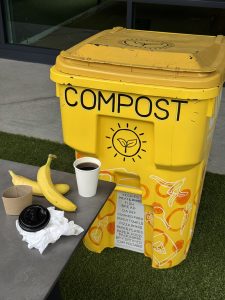
Our story begins with a banana peel.
Instead of being tossed down the trash chute and sent to a landfill, this banana peel gets a second chance. A resident collects it with their other food scraps and drops it into their building’s CompostNow bin.
And that’s really the hardest part of the process.
Composting is remarkably simple. If it grows, it goes. Fruit peels, vegetables, coffee grounds, eggshells, bread, bones, meat scraps, dairy, and leftovers can all be composted through CompostNow’s industrial composting system.
Once collected, your food scraps are no longer considered waste. They’re a future soil amendment waiting to happen.
Step 2: The Sorting Facility – East Point, Atlanta
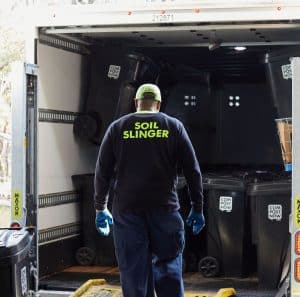 Next, the banana peel heads to CompostNow’s processing facility in East Point.
Here, food scraps from apartments, restaurants, offices, and homes across metro Atlanta are brought together before making their journey to the composting site.
Here’s what happens:
- Everything gets checked for contamination (the most common offenders are small sauce containers, dog waste bags, and non-compostable plastics).
- Bins are emptied into a big truck, consolidating food scraps for transport to the next location.
- Bins are cleaned—so residents get a fresh one each week, keeping pests and smells away.
Step 3: The Compost Magic – Southern Soil Works in Grantsville, GA
And now…the place where banana peels go to be reborn.
CompostNow’s composting site (Southern Soil Works) is out in Grantsville, next to a landfill—but what’s happening there is the polar opposite of trash. They’re turning over 6,000 tons of food scraps into compost every year—with plans to scale to 50,000 tons.
Food scraps are mixed with wood waste and formed into long rows called windrows. These rows are carefully monitored and turned regularly to introduce oxygen and maintain ideal composting conditions.
Here’s a breakdown of the CompostNow process:
- Greens (food scraps) are mixed with browns (wood waste).
- They’re piled into long rows—called windrows.
- As the organic matter starts breaking down, the temperature inside reaches up to 140°F. That heat is too intense for worms—so microbes take over. They break everything down quickly and safely. In just two weeks, you can barely tell what used to be a banana peel or chicken bone.
- The piles get “turned” often to introduce oxygen and prevent overheating (compost CAN catch fire!).
- After about two months, what used to be food is now dark, nutrient-rich compost that will go on to nourish farms and gardens.
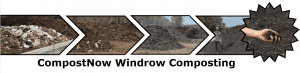
It will cure for a few more months—but it’s pretty incredible. For decades we’ve buried all this material in landfills where it can’t break down properly—creating methane and missing the chance to put nutrients back into our soil. Meanwhile, we built whole industries to make artificial fertilizer. We had the nutrients all along.
Step 4: Back to the Soil
This is where the story comes full circle.
After months of careful composting, our banana peel has been transformed into a nutrient-rich soil amendment. Unlike fertilizers, which primarily add nutrients to plants, compost improves the soil itself.
Think of compost as a multivitamin for the ground.
Farmers, landscapers, community gardens, and parks use compost to:
- Improve soil structure and reduce compaction
- Increase the soil’s ability to hold water, reducing irrigation needs
- Slowly release nutrients that plants can access over time
- Support beneficial microbes and organisms that create healthy soil ecosystems
- Reduce erosion and help establish stronger root systems
Healthy soil is the foundation of healthy plants. In many urban and agricultural settings, soils have become depleted from years of development, construction, or intensive growing practices. Compost helps rebuild that soil naturally by returning organic matter and nutrients back to the ground.
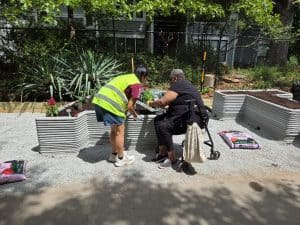
The finished compost produced by CompostNow is used throughout Georgia on farms, landscaping projects, community gardens, and green spaces. Customers can even request compost back for use in their own gardens or choose to donate it to local nonprofit projects.
In fact, at the conclusion of the BuckheadCOMPOSTS program, Livable Buckhead plans to use compost generated through the initiative in a community planting project along PATH400. The food scraps collected from Buckhead residents today will help support the trees, plants, and green spaces that make our neighborhood beautiful tomorrow.
That’s the real magic of composting. A banana peel that might have been thrown away becomes part of the next generation of healthy soil, thriving plants, and vibrant communities.
Closing the Loop
Every day, we make decisions about what to do with our food scraps.
For decades, most of those scraps have been buried in landfills. But composting offers another path—one that captures the value still left in those materials and returns it to the soil.
So the next time you toss a banana peel into your BuckheadCOMPOSTS bin, remember:
It isn’t the end of the story.
It’s just the beginning.