

Breaking Down the Metro Atlanta Climate Action Plan
The Atlanta Regional Commission (ARC) released the Metro Atlanta Climate Action Plan (MACAP) — a comprehensive roadmap outlining how our region can significantly reduce greenhouse gas emissions over the coming decades.
The MACAP is not legislation or a new policy, its guidance. ARC does not have the authority to implement climate policies across the region. Instead, it supports its member governments, nonprofits, and regional stakeholders by:
- Providing data and technical analysis
- Drafting model policies and legislation
- Helping secure funding
- Coordinating regional collaboration
Each city and county ultimately decides if and how to adopt strategies that align with the shared regional goals.
Think of this plan as a playbook for local action.
Setting the Baseline
Every effective climate plan begins with measurement.
ARC first conducted a comprehensive greenhouse gas (GHG) inventory for the Atlanta Metropolitan Statistical Area (MSA), analyzing emissions from 2005 through 2022. This inventory measured where emissions are coming from and how they’ve changed over time.
Where Emissions Stand Today
In 2022, economy-wide emissions totaled 74.95 million metric tons (MMT) of CO₂e, down from 89.61 MMT in 2005.
Emissions by sector in 2022:
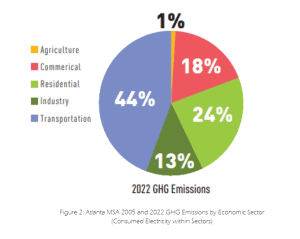
(These sectors include emissions from the energy they consume.)
Transportation is clearly the largest contributor — no surprise for us Atlantians.
How Emissions Have Changed
Since 2005, overall regional emissions have declined, with a sharp dip in 2020 during the pandemic and a rebound by 2022 as economic activity resumed. Emissions tied to electricity consumption have fallen significantly over the long term, reflecting improved efficiency and a somewhat cleaner grid. However, transportation emissions have increased — now representing 44% of the region’s total — driven by population growth, increased vehicle miles traveled, and reduced transit use. Residential emissions have also recently ticked upward, while waste-related emissions grew substantially over the past decade before beginning to stabilize. Meanwhile, trees and greenspace continue to offset roughly 7% of total emissions annually. These trends help clarify where the region must focus its efforts moving forward and where the greatest opportunities for impact lie.
The Regional Goals
Based on this data, the Atlanta MSA established clear reduction targets:
- Reduce economy-wide GHG emissions 50% below 2005 levels by 2035
- Reduce emissions 80–85% below 2005 levels by 2050
These targets would bring the region close to net-zero carbon emissions by mid-century.
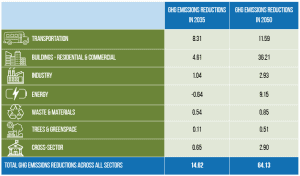
The MACAP then outlines sector-by-sector strategies to reach those goals.
Near-Term: Transportation Leads the Way
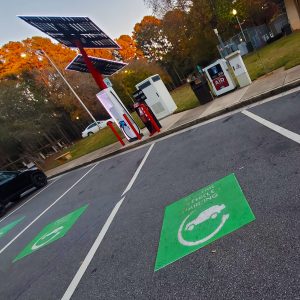 In the next decade, the ARC predicts that the largest opportunities for emissions reductions come from transportation.
This would largely be driven by:
- Increased adoption of electric vehicles (EVs)
- Expansion of charging infrastructure
- Reduce Vehicle Miles Traveled (more transit, biking, walking, carpooling)
- Fleet electrification
Because transportation is currently the region’s largest source of emissions, even modest shifts — especially toward EV adoption — create meaningful reductions.
The plan suggests that electrification of passenger vehicles will carry much of the early momentum.
Long-Term: Buildings Become the Big Lever
 Over time, the most substantial reductions come from the buildings sector — both residential and commercial.
Key strategies include:
- Stronger energy efficiency codes & green building standards
- Electrification of heating systems
- Retrofitting existing homes and buildings
New construction is important, and updating building codes drives the largest reductions in the long term. But, retrofitting existing buildings is still critical. Much of the region’s 2050 building stock already exists today, meaning upgrades to HVAC systems, appliances, and insulation will also drive long-term emissions cuts.
Limited Reductions from the Energy Sector
One of the more notable observations in the MACAP is that relatively small emissions reductions are projected from the energy production sector itself.
Instead, most reductions tied to electricity come from demand-side response, shifting energy use to off-peak hours, smart appliances and load management, and improved efficiency in how energy is consumed
This is because the region has limited direct control over how electricity is generated. Utilities determine generation mix, and Georgia has not signaled a rapid transition away from fossil fuels. As a result, the plan focuses heavily on reducing energy demand within buildings rather than assuming major changes in how power is produced.
In other words: if we can’t quickly change how electricity is made, we can reduce how much we need.
Smaller but Targeted Impact from Industry, Waste & Materials
Industrial electrification and efficiency improvements show more modest reductions overall. However, modernization in this sector can improve productivity and reduce downtime — a meaningful co-benefit.
Waste and materials strategies also represent a smaller share of reductions. The focus here is primarily on:
- Reducing food waste
- Diverting organic materials
- Managing wood waste from construction
These materials generate methane when decomposing in landfills — and methane is significantly more potent than carbon dioxide in the short term.
The Role of Trees and Natural Lands
The plan also emphasizes protecting and expanding tree canopy and greenspace.
In 2022, metro Atlanta’s natural lands sequestered approximately 5.2 million metric tons of CO₂e, offsetting about 7% of total regional emissions.
While the direct emissions impact may be smaller compared to transportation and buildings, the co-benefits are substantial: heat mitigation, stormwater management, air quality improvement, and enhanced quality of life.
Going Beyond Carbon
What Happens Next?
The MACAP sets shared regional goals and outlines pathways to achieve them — but implementation will occur locally.
Cities and counties can:
- Adopt stronger building codes
- Incentivize EV infrastructure
- Update zoning to support walkability
- Expand tree protection policies
- Develop retrofit programs
ARC can support these efforts with policy drafting, funding assistance, and technical guidance — but progress ultimately depends on member governments choosing to act.
At Livable Buckhead, we’ll work with our partners at the City, Buckhead CID, local building owners, employers, and residents to do what we can to facilitate the realization of these GHG reduction strategies for our neighborhood.
Livable Buckhead is hosting the ARC for an information session to review the MACAP and discuss future initiatives to reach the plans goals on March 26th at 12:00pm. Email helen@livablebuckhead.org if you are interested in attending.